If you’ve spent the last year watching your organic traffic behave strangely — impressions holding steady while clicks quietly slide — you’ve already felt the effect of GEO, even if nobody told you what to call it.
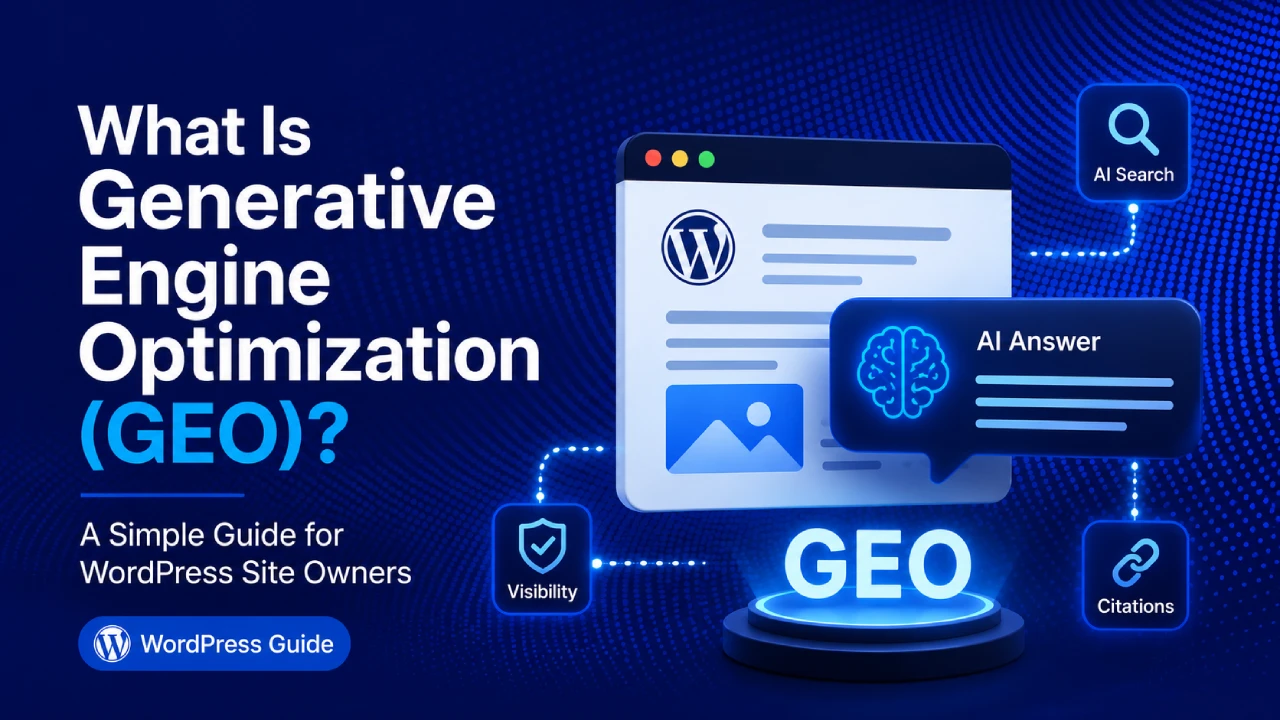
Generative Engine Optimization (GEO) is the practice of structuring your website’s content so AI systems — ChatGPT, Perplexity, Google AI Overviews, Gemini, Copilot — can find it, understand it, and use it (with attribution) when they generate an answer. Where SEO competes for a spot on the results page, GEO competes for a spot inside the answer itself.
That one-sentence version is enough to get the gist. But if you run a WordPress site, “understand what GEO means” isn’t actually the hard part — the hard part is figuring out what it changes about the site you already have. That’s what this guide is for.
Where the Term “GEO” Actually Comes From
GEO isn’t marketing-department slang. It was coined in a 2023 research paper, “GEO: Generative Engine Optimization,” published by researchers at Princeton University, Georgia Tech, the Allen Institute for AI, and IBM Research. The paper’s core finding still holds up: content that’s optimized purely for traditional search ranking signals doesn’t automatically perform well inside AI-generated answers. The two systems reward different things, and the researchers built a benchmark specifically to measure “visibility” inside generative responses rather than click-through rankings.
That academic origin matters for one practical reason: GEO is a measurable, testable discipline, not a vague buzzword. There’s a real body of research behind why certain content gets cited by AI systems and other content doesn’t — and it’s grounded in how these systems retrieve and assemble information, not in speculation.
GEO vs. SEO vs. AEO: Untangling the Acronyms
You’ll see three overlapping terms thrown around, often incorrectly, as if they’re interchangeable. They’re related, but distinct enough to be worth separating clearly.
| SEO (Search Engine Optimization) | AEO (Answer Engine Optimization) | GEO (Generative Engine Optimization) | |
|---|---|---|---|
| Primary goal | Rank in the top positions of search results | Be selected as the direct answer to a specific question | Be referenced, cited, or summarized inside an AI-generated response |
| Platforms | Google, Bing (traditional results) | Featured snippets, voice assistants, People Also Ask | ChatGPT, Perplexity, Google AI Overviews/AI Mode, Gemini, Copilot |
| Success metric | Rankings, organic clicks, traffic | Snippet ownership, position zero | Citation frequency, share of voice, AI mentions |
| Content shape | Keyword-targeted pages, backlink-driven authority | Single, direct, concise answers to one question | Self-contained, extractable passages usable across many contexts |
| How you win | Backlinks, keywords, technical SEO, domain authority | Precisely matching question phrasing | Clarity, structure, entity consistency, credible mentions across the web |
In practice, these three overlap more than they conflict. Google itself has stated that from Search’s perspective, optimizing for AI-generated features is still just SEO — because AI Overviews and AI Mode are built on top of the same core ranking and retrieval systems that power regular search. AEO is really a subset of GEO focused on single-answer formats like snippets. Think of it less as three separate strategies and more as three lenses pointed at the same underlying goal: being the source AI trusts enough to use.
The Confusion Nobody Clears Up: Google’s AI Overviews vs. Chatbot GEO
Here’s where most articles on this topic — including some very well-known ones — quietly contradict each other, and where most of the reader confusion actually lives.
Google’s own Search Central documentation says something specific: for Google’s AI Overviews and AI Mode, you don’t need llms.txt files, you don’t need to “chunk” your content into unnatural fragments, and you don’t need to obsess over schema markup beyond normal best practice. Google’s generative features are built on Google’s existing Search index and ranking systems (a technique called retrieval-augmented generation, or RAG) — so if your site is already technically sound and indexed, you’re already eligible. Overengineering for AI Overviews specifically can actually violate Google’s spam policies.
But that guidance is specific to Google. ChatGPT, Perplexity, and other third-party AI platforms work differently. Some rely on real-time web retrieval (Perplexity, ChatGPT with browsing/search enabled), and some rely partly on what was baked into the model during training. For the retrieval-based platforms, structure and extractability genuinely do matter more, because these systems break your page into chunks, convert them into vector representations, and pull the most relevant passage — often without the surrounding context of your full article.
So the honest answer is: it depends which “AI search” you’re optimizing for.
- Optimizing for Google’s AI Overviews → keep doing excellent, technically sound, indexed, people-first SEO. Google explicitly says you don’t need special AI-only tactics.
- Optimizing for ChatGPT, Perplexity, and similar retrieval-based tools → structure matters more: self-contained paragraphs, clear headings, front-loaded answers, and consistent entity signals across the web (your site, LinkedIn, review platforms, Wikipedia if applicable) all genuinely help.
This is the single most useful distinction in this entire topic, and it’s the one thing worth remembering above everything else in this guide.
How AI Actually Builds an Answer
You don’t need to understand the math behind large language models to do GEO well, but a rough mental model of the mechanism helps everything else make sense.
- A user asks a question. “What’s the best way to speed up a WordPress site?”
- The AI system decides whether it needs current information. If it’s a retrieval-based tool (ChatGPT with browsing, Perplexity, Google AI Mode), it runs a search behind the scenes — sometimes several related searches at once, a process Google calls “query fan-out.”
- It retrieves candidate pages from across the web (or its own index) that look relevant.
- It breaks those pages into smaller chunks and evaluates which specific passages most directly answer the question — not which page overall ranks best, but which paragraph is most useful.
- It stitches the best passages together into a single, synthesized response, sometimes with a citation link, sometimes without one.
The practical implication: your article’s overall quality still matters (it has to earn the retrieval step), but individual paragraphs are now competing for extraction on their own. A paragraph that says “as mentioned earlier, this approach works better” makes no sense when it’s lifted out of context and dropped into someone else’s chatbot answer. A paragraph that states the fact plainly and completely survives that trip intact.
Does GEO Actually Matter for a Small WordPress Site Yet?
Honest answer: it depends on your niche and your traffic sources, and you shouldn’t panic-rebuild your site over this.
It matters more if:
- You publish informational, how-to, or comparison content where people historically searched Google for a quick answer
- Your niche overlaps with topics people now ask ChatGPT or Perplexity directly (tech, finance, health, “best X for Y” comparisons)
- You’ve noticed impressions holding steady in Search Console while clicks decline — a common early signal of AI Overviews absorbing your traffic
It matters less (for now) if:
- Your traffic is largely branded, direct, social, or email-driven
- You’re in a highly transactional or local-service niche where users still want to click through to book, buy, or compare directly
- Your content already follows strong SEO fundamentals — you’re closer to “GEO-ready” than you think, because the two disciplines overlap heavily
The reassuring part: nothing here asks you to abandon SEO or rebuild your site from scratch. Every major source on this topic — including Google itself — agrees that GEO builds on solid SEO rather than replacing it. If your content is well-written, well-structured, technically accessible, and genuinely useful, you’re doing most of the work already.
7-Point GEO Readiness Checklist for WordPress Sites
Run through this list against a few of your top-performing posts:
- Does your opening paragraph answer the core question directly, without a throat-clearing intro? (Front-loaded answers get extracted more often.)
- Can each major paragraph stand alone if it were lifted out and pasted somewhere else, with no “as discussed above” references?
- Do your headings clearly signal what question each section answers, rather than being clever or vague?
- Is your site fast, mobile-friendly, and free of heavy client-side rendering that could block AI crawlers from reading your content? (JavaScript-heavy WordPress themes/builders are a common blind spot.)
- Do you have consistent entity signals — the same description of who you are and what you do — across your site, author bio, LinkedIn, and any directory or review site listings?
- Does your content include specific facts, numbers, or data points, not just general statements? (Concrete claims are easier for AI systems to extract and trust than vague ones.)
- Are your author credentials visible and consistent (a real bio, credentials, and — where relevant — first-hand experience)? E-E-A-T signals influence not just whether AI cites you, but how confidently it frames that citation.
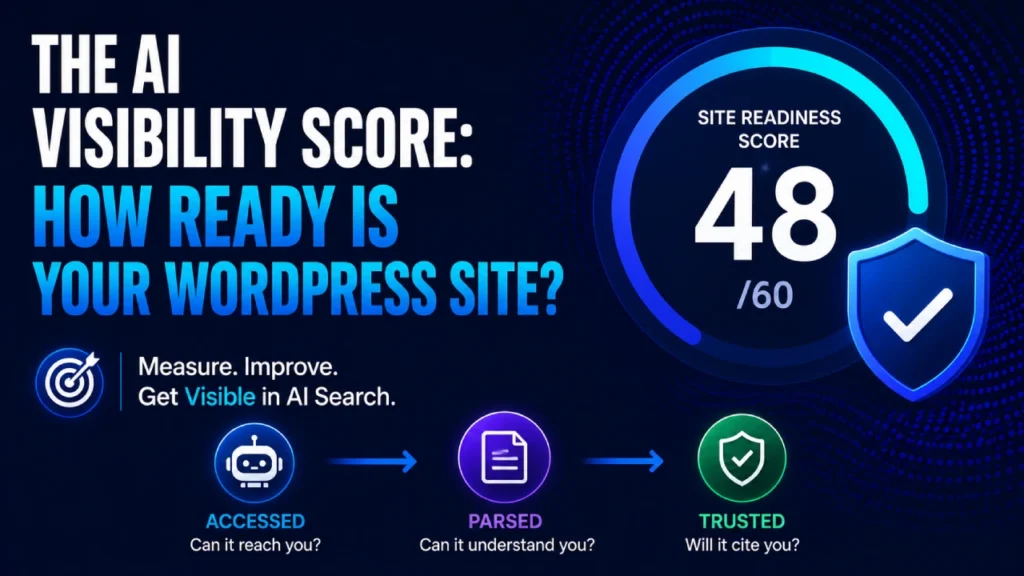
If you can check most of these off, you’re already ahead of most of the WordPress content you’re competing against. We’ll turn this checklist into an actual scored framework in an upcoming article on the AI Visibility Score.
Quick GEO Glossary
| Term | Plain-English Meaning |
|---|---|
| RAG (Retrieval-Augmented Generation) | The technique AI systems use to fetch current web content before generating an answer, instead of relying only on what they learned during training |
| Chunking | Breaking a page into smaller passages so an AI system can evaluate and extract the most relevant part |
| AI Overview | Google’s AI-generated summary that appears above traditional search results for many queries |
| Citation / Mention | An instance where an AI-generated answer references or names your brand or content, with or without a clickable link |
| Entity | A distinct, identifiable “thing” (a brand, person, product) that AI systems learn to recognize and categorize consistently across sources |
| Share of Voice | How often your brand appears in AI answers compared to your competitors, for a given topic or question set |
| Query Fan-Out | When an AI system generates several related searches behind the scenes to answer one user question more thoroughly |
A Worked Example: The Same Fact, Written Two Ways
The difference between GEO-friendly and GEO-unfriendly writing is easier to see than to explain. Take a common WordPress topic — caching plugins — and look at two ways of stating the same idea.
Hard to extract: “There are a few reasons this matters. Once you try it, most site owners notice things feel snappier. That’s part of why so many people recommend it.”
An AI system pulling this passage out of context gets almost nothing usable — no subject, no number, no concrete claim.
Easy to extract: “Enabling page caching on a WordPress site typically cuts load times by reducing server processing on repeat visits, since cached pages are served as static files instead of being rebuilt on every request.”
Same underlying idea, but the second version names the mechanism, states the effect, and makes sense entirely on its own — with no need for the reader (or the AI system) to already know what “it” refers to. Multiply that pattern across every paragraph in a post that makes a claim, explains a term, or compares two options, and you’ve done most of the practical work of GEO without touching a plugin setting.
This is also where WordPress site owners have a structural advantage over larger enterprise sites: shorter, focused posts written around a single topic naturally produce more self-contained paragraphs than sprawling, ten-thousand-word enterprise guides that bury key facts three paragraphs deep in dense prose.
How to Actually Measure Whether It’s Working
One of the more uncomfortable truths about GEO is that your existing analytics stack — Google Analytics, Search Console — was not built to see it. When ChatGPT or Perplexity summarizes your content in an answer, that interaction often never generates a click at all. The user reads the answer, gets what they need, and moves on. If they do act on it later — searching your brand name a week afterward, for instance — nothing in your dashboard connects that action back to the AI mention that started it.
That doesn’t mean GEO is unmeasurable, just that it needs a different set of signals layered on top of your usual reporting:
- Citation frequency — how often AI platforms mention your brand or content when answering relevant questions in your niche
- Share of voice — your mention rate compared to competitors covering the same topics
- Context tracking — which specific questions or prompts trigger your brand being mentioned at all, versus topics where you’re invisible
- Sentiment — whether the mentions that do happen frame you positively, neutrally, or negatively (a high mention count means little if the framing is bad)
For most WordPress bloggers and small site owners, dedicated AI-visibility tracking tools are optional rather than essential at this stage — you can get a reasonable read by manually asking ChatGPT and Perplexity a handful of your target questions every month or two and noting whether you show up. As the space matures, expect this kind of tracking to become as routine as checking keyword rankings is today.
Frequently Asked Questions
Is GEO replacing SEO? No. Every major source on this topic — Google included — treats GEO as an extension of SEO, not a replacement for it. The sites that already follow strong SEO fundamentals (technical accessibility, quality content, clear structure, credibility signals) are the ones best positioned for AI visibility too.
Do I need an llms.txt file for my WordPress site? Not for Google Search or its AI features — Google has explicitly said it doesn’t use llms.txt files. It may have some relevance for other AI platforms and crawlers that choose to support the emerging standard, but it isn’t a requirement, and it won’t hurt your site if you skip it for now. (We’ll cover llms.txt in full detail in a dedicated guide.)
How is GEO different from just “good SEO”? The overlap is large, but GEO adds an emphasis on self-contained, extractable content — paragraphs that make sense out of context — and on consistent entity signals across platforms beyond your own website, since AI systems pull from Reddit, YouTube, review sites, and social platforms, not just your blog.
What’s the fastest way to start with GEO on an existing WordPress site? Start with the readiness checklist above on your three or four best-performing posts. Rewrite opening paragraphs to answer the core question immediately, tighten up self-contained explanations, and make sure your author bio and site description are consistent everywhere they appear online.
Will GEO tools tell me exactly how to rank in ChatGPT? No tool — including ones built by major SEO platforms — has access to the internal ranking or retrieval systems of ChatGPT, Perplexity, or Google. What these tools can do is track your citation frequency and share of voice over time, which is useful for measuring progress, not for reverse-engineering a guaranteed formula.
Where to Go From Here
This article covers the foundation — what GEO is and how it fits alongside SEO. From here, the natural next steps are:
- SEO vs. GEO: What’s Actually Changing in 2026 — a deeper side-by-side breakdown
- The AI Visibility Score: How Ready Is Your Site? — turning the checklist above into a scored framework
- llms.txt Explained: Do WordPress Sites Actually Need One?
- WordPress GEO Workflow: Setting Up Your Site Step by Step
GEO isn’t a trend to panic over, and it isn’t something you can “install” your way into with a plugin alone. It’s a natural extension of doing SEO well in a search landscape that now includes AI-generated answers alongside traditional results — and for most WordPress site owners, getting ready for it starts with paragraphs you’ve probably already written.