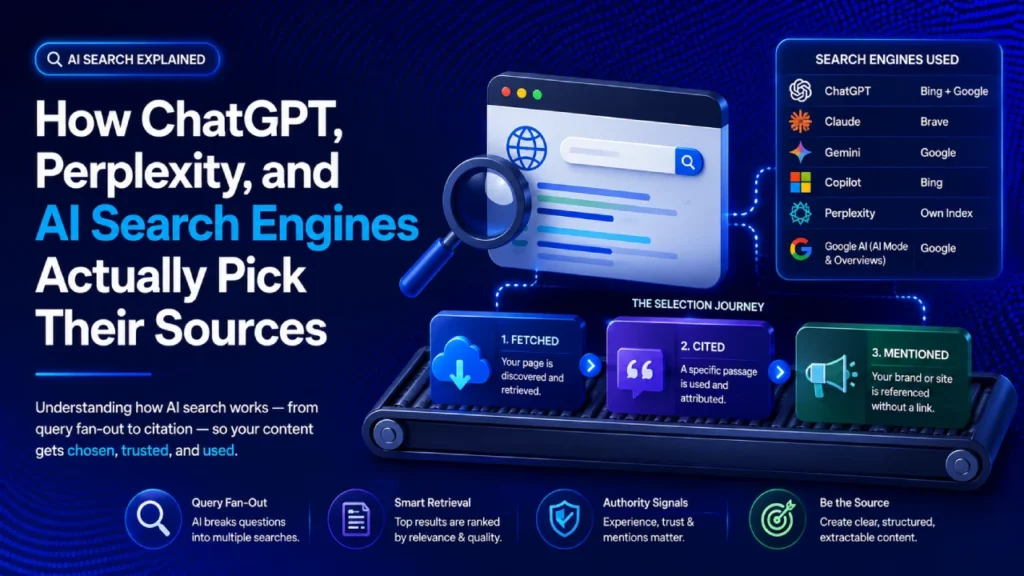
Most content advice for AI search visibility stops at “write clearly and answer questions directly.” That’s not wrong, but it’s also not enough — it describes a quality standard without explaining what structural choices produce the outcome.
There are six specific structural changes that shift a WordPress post from “relevant but never cited” to “regularly extracted and cited.” All six connect to the same underlying mechanic from Day 3 of this series: AI retrieval systems evaluate and extract at the passage level, not the page level. A post can be highly relevant to a question and still go uncited if no individual passage within it is cleanly extractable on its own. These six changes fix that.
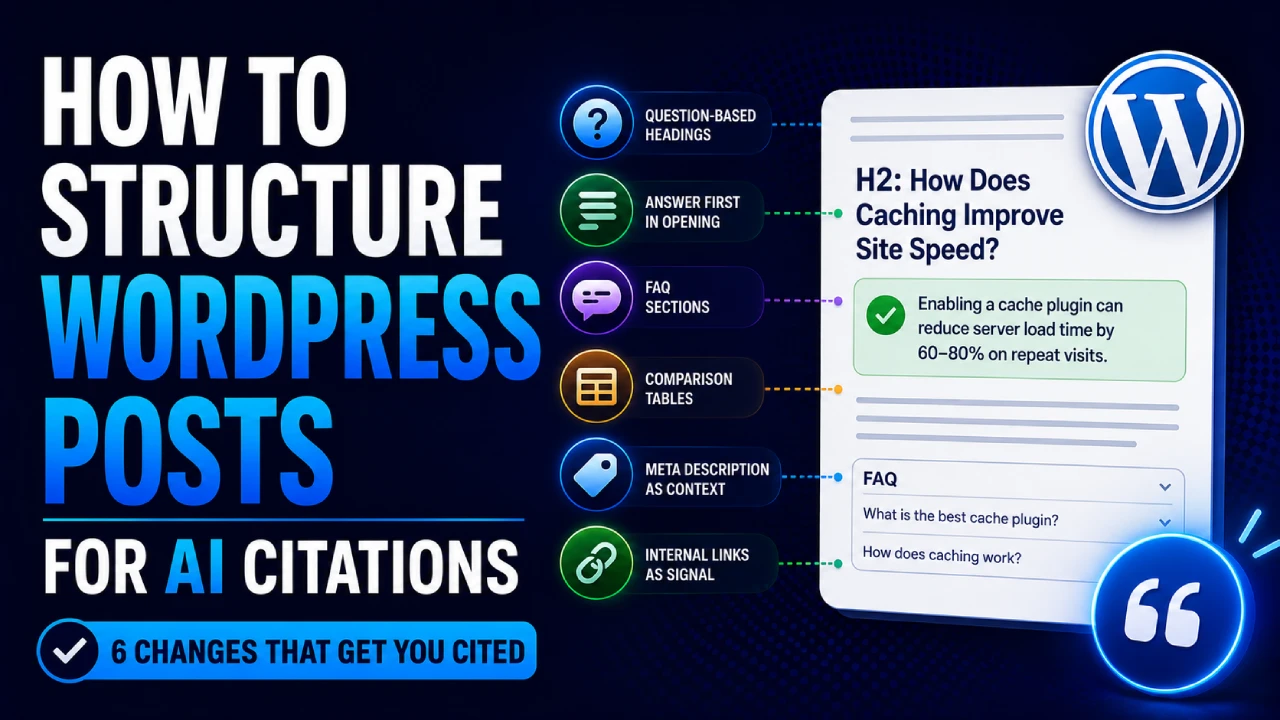
The changes are: question-based headings, inverted-pyramid opening paragraphs, FAQ sections, comparison tables, meta descriptions written as context signals, and internal linking as topical signal. This article explains what each one does, shows a before/after example for each, and ends with a pre-publish checklist you can run on every post going forward and a triage framework for your existing archive.
Why Structure Matters Differently for GEO Than for SEO
Traditional SEO optimizes a page to be relevant to a keyword. AI retrieval optimizes individual passages within a page to be extractable for a specific claim.
The distinction matters because these are different optimization targets. A page optimized for SEO might have a clear keyword focus, a descriptive title, reasonable heading hierarchy, and good backlinks — and still go uncited by AI systems because its key facts are buried inside long paragraphs that make no sense when lifted out of context.
Court documents from Google’s antitrust case revealed something that explains this directly: Google’s FastSearch system, which grounds AI Overviews, retrieves fewer documents than regular search and relies on lighter ranking signals focused on semantic clarity — specifically, how closely content aligns with the meaning of a question, rather than authority signals like backlinks. This means that for AI-generated answers, a small, well-structured post on a clear topic can outperform a large, authoritative post whose key facts aren’t organized for extraction.
The practical implication: SEO asks “is this page about the right topic?” GEO asks “is this specific passage answer-worthy on its own?” Post structure is the mechanism that determines the answer to the second question.
Change 1: Question-Based Headings
What this does: Every H2 and H3 heading creates a natural chunk boundary in how AI retrieval systems parse content. The text beneath a heading is evaluated largely as a standalone unit — the heading tells the system what question that unit is trying to answer, and the following content is judged on how directly and completely it does so.
A vague or keyword-stuffed heading gives the system no context for what question the following passage answers. A question-phrased heading maps the content directly to the queries AI systems are trying to answer on a user’s behalf.
Before:
H2: Page Speed Optimization
After:
H2: How Does Page Speed Affect Your WordPress Site’s AI Search Visibility?
The second version does two things the first doesn’t: it signals a specific question the following passage will answer, and it maps to the conversational query format users actually use when asking AI systems about page speed.
Practical rule: For your most important H2s — the ones covering your post’s core claims — phrase them as the question a user would type into ChatGPT to get the answer your section provides. This doesn’t mean every heading needs a question mark; navigational headings like “Installation Steps” or “Pricing” work fine as-is. Reserve the question format for explanatory, definitional, and comparison sections where the “why” or “how” is what you’re actually answering.
Change 2: Opening Paragraph Architecture — Answer First
What this does: AI retrieval systems looking for a passage to extract for a specific claim evaluate early-passage content first. A post that spends two paragraphs setting context before stating its core claim will lose citations to a post that states the claim in the first sentence.
This is the inverted pyramid principle applied to AI extraction. The answer comes first. The context, background, and elaboration follow. It’s the opposite of how most SEO-oriented content has been written for years — building toward a conclusion — and it’s the single most important structural habit for GEO.
Before:
“If you’ve been running a WordPress site for any length of time, you’ve probably heard about caching. It’s one of those topics that comes up constantly in performance discussions. But understanding why it matters and which plugin to choose isn’t always obvious. In this section, we’ll break down the options.”
After:
“Enabling a page cache plugin for WordPress typically reduces server load time by 60–80% on repeat visits, because cached pages are served as static HTML files instead of being rebuilt from the database on every request. WP Super Cache, W3 Total Cache, and WP Rocket are the three most widely used options, each suited to different hosting environments.”
The second version states the mechanism, the benefit, and the relevant options in the first two sentences. An AI system extracting this passage gets a complete, citable claim. The first version gives it scene-setting prose that only makes sense in context.
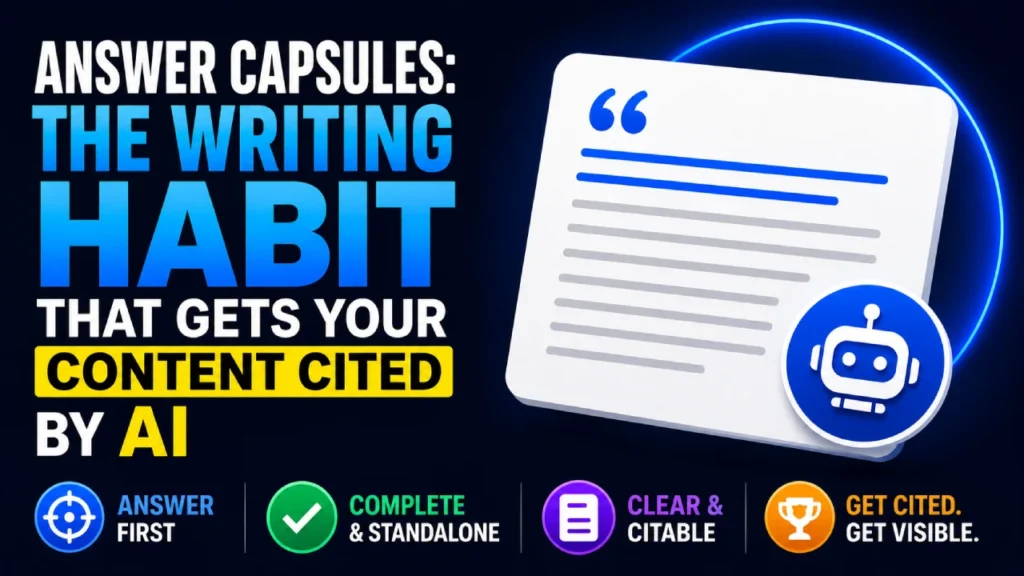
Day 9 of this series goes deeper on this habit — including a framework for writing every paragraph so it functions as a standalone answer capsule, not just the opening paragraph.
Change 3: FAQ Sections — Placement and Format
What this does: FAQ sections are disproportionately valuable for AI extraction compared to their SEO value, for a specific mechanical reason: each FAQ entry is a naturally self-contained question-and-answer unit. The question clearly identifies what’s being answered, and the answer is scoped specifically to that question. AI systems can extract a single FAQ entry cleanly, without needing any surrounding context, which is exactly what makes passages citable.
FAQ sections also serve a second function: they surface the specific sub-questions your post’s main topic generates, which may not fit naturally into your narrative but are exactly what users ask AI systems in follow-up prompts.
Format that works best for AI extraction:
Each FAQ entry should have:
- A question formatted as a direct user query (“How long does page caching take to set up?”)
- An answer that states the core fact in the first sentence (not “that depends” or “great question”)
- A complete answer in 40–80 words — enough to be self-contained, short enough to be extractable
- No cross-references like “as mentioned above” or “see the section on X” that lose meaning out of context
Placement: FAQ sections work best at the end of a post (after the main content) or at the end of a specific section that generates predictable sub-questions. Adding FAQPage schema markup to your FAQ section makes the structure machine-readable — Yoast, Rank Math, and AIOSEO all support this natively. It’s not confirmed to directly increase AI citation rates, but it costs nothing to add and helps both structured search features and AI context parsing.
How many FAQ entries: Three to seven is the useful range. Fewer than three starts to feel perfunctory. More than seven starts to dilute the signal — AI systems often extract only the most directly relevant entry, so adding more entries doesn’t proportionally increase citation odds; it mainly adds maintenance overhead.
Change 4: Tables and Comparison Formats
What this does: Tables are among the most extractable content formats AI systems can encounter. When a user asks a comparison question — “which WordPress caching plugin is fastest?”, “what’s the difference between WooCommerce and Easy Digital Downloads?” — an AI system searching for a passage to answer that question will almost always prefer a structured table over prose comparisons, because the table provides the comparative data with zero ambiguity about which attribute belongs to which subject.
This isn’t a theory. Day 3 of this series noted that one analysis found tables get extracted almost verbatim more often than any other content format — because the structure itself does the organizational work the AI would otherwise need to perform.
What makes a table citable vs. decorative:
A citable table has a clear descriptive caption or heading that identifies what’s being compared and on what criteria. The column headers name the attributes being compared, not just “Option 1,” “Option 2.” Each cell contains a concrete value — a time, a price, a yes/no, a brief description — not a paragraph of prose. And the table can be understood without reading the surrounding text.
A decorative table uses rows and columns for visual formatting but doesn’t actually contain comparative data AI could extract to answer a comparison question.
Practical application: For any post that compares tools, approaches, or options, convert at least one comparison into a table. For step-by-step guides, consider a summary table of steps with their purpose. For definitional posts, a “quick reference” table of key terms can serve as an extractable anchor even when the surrounding prose is narrative.
Change 5: Meta Descriptions as AI Context Signals
What this does: This is the most overlooked structural layer in GEO content optimization, and it’s genuinely underexplored in the existing literature. When AI retrieval systems evaluate which pages to fetch for a given query, they often scan page snippets — short text extracts that include the meta description — before deciding whether to load the full page. A meta description written as a miniature answer capsule gives the system enough information to recognize your page as relevant to a specific claim before it’s even fully fetched.
Most meta descriptions are still written as promotional summaries: “Learn everything you need to know about WordPress caching in our comprehensive guide.” This tells the AI system the page is about caching, but it doesn’t demonstrate that the page directly answers any specific question.
Before:
“Everything you need to know about WordPress page caching — a comprehensive guide for site owners looking to improve their performance.”
After:
“Page caching in WordPress reduces server load by 60–80% on repeat visits. WP Super Cache is free and lightweight; WP Rocket is the fastest but paid; W3 Total Cache offers the most configuration options.”
The second version states concrete facts, names specific entities (the three plugins), and gives a system enough to determine whether this page answers questions about caching plugin comparisons — before the full page is fetched.
Practical limit: Meta descriptions are typically constrained to 150–160 characters. Use the first sentence for the core fact or recommendation; use the second for specifics or a named qualifier. Front-load the most specific, quotable claim you can fit.
Change 6: Internal Linking as Topical Signal
What this does: Internal links between related posts reinforce topical authority — they signal to both traditional search engines and AI retrieval systems that this post belongs to a coherent cluster of content on a topic, not a standalone island. From an AI retrieval perspective, topical consistency across a site affects how confidently the system categorizes and cites content from that site for topic-specific questions.
This is the post-level application of the silo architecture principle — at the site level, related content should be connected; at the post level, each individual post should link to the related posts that round out the topic.
Practical guidance for WordPress posts:
Aim for three to five meaningful internal links per post, not decorative link-for-link’s-sake connections. Each link should connect to a post that a reader would naturally want to consult next — if someone reads your post on WordPress caching, they might naturally want your post on page speed testing, or your post on CDN setup. Link those explicitly.
Write descriptive anchor text that names what the linked page covers (“a complete guide to WordPress CDN configuration”) rather than generic text (“click here” or “read more”). Descriptive anchor text provides additional topical signal beyond just the URL.
In WordPress specifically: posts within the same category or with shared tags have implicit topical grouping — but AI systems don’t read category taxonomy the same way humans navigate it. Explicit contextual internal links within the body of posts are more valuable than relying on related-posts widgets or navigation menus.
Post Length: The Honest Answer
There’s a genuine tension in GEO content advice that nobody resolves cleanly: traditional SEO tends to reward longer, more comprehensive posts, while GEO advice emphasizes short, extractable passages. Both camps state their position without acknowledging the other.
The honest resolution: total post length matters less for AI extraction than whether each section is self-contained and extractable. A 500-word post where every paragraph is answer-worthy will out-cite a 4,000-word post whose key facts are buried in dense narrative. At the same time, a 4,000-word post with strong section structure that applies everything in this article will out-cite both.
There’s no ideal word count for GEO. There is an ideal structure standard: every H2 section should be interpretable as a complete answer to the question its heading poses, independent of the rest of the post. If your current post meets that standard at 800 words, don’t pad it. If it doesn’t meet that standard at 3,000 words, restructuring matters more than trimming.
For existing posts being retrofitted: you don’t need to change the total length. You need to check whether the opening sentence of each major section states its core claim directly. That’s the adjustment that changes citation outcomes.
The Pre-Publish Checklist
Run through this before hitting Publish on any post you want AI systems to cite:
- H1: Does the post title state the specific question or topic clearly, in terms a user would actually search?
- Opening paragraph: Does the first paragraph state the core claim or answer the primary question directly — without a warm-up intro?
- H2/H3 headings: Do the major section headings identify the question each section answers? (At least your three most important sections)
- Section independence: Can each major section be read and understood without the surrounding context? (No “as we covered above,” no pronoun-only references to earlier sections)
- FAQ section: Is there a FAQ block covering the three to five specific sub-questions this topic generates?
- Tables: If the post compares options, tools, or approaches, is at least one comparison formatted as a table with descriptive headers?
- Meta description: Does the meta description state at least one concrete, specific fact — not just describe what the post covers?
- Internal links: Does the post include three to five links to closely related posts in the same topic cluster, with descriptive anchor text?
- Author bio: Is the author bio visible on this post with real credentials or experience signals?
Nine checkboxes. A post that passes all nine is structurally positioned for AI extraction. A post that fails three or more of them has structural gaps more consequential than any keyword optimization.
Retroactive Audit: Which Existing Posts to Fix First
Most WordPress content sites have dozens or hundreds of existing posts. Retrofitting all of them isn’t realistic. Here’s a triage framework:
Tier 1 — Fix immediately: Posts currently driving meaningful organic traffic from traditional search on questions your niche’s users are also asking AI systems. These posts already have topical relevance signal; they just need structural cleanup to become citable. Check their opening paragraphs and H2 structure first.
Tier 2 — Fix next quarter: Posts that cover topics where you have strong opinions or experience but low traffic — these are often structurally thin because they were written for completeness rather than search. They’re worth retrofitting if the topic is one where AI system citations would actually drive brand recognition.
Tier 3 — Leave or refresh entirely: Very old posts (3+ years) covering topics where the information has materially changed, or posts that are thin on substance regardless of structure. Structural improvements can’t fix a post that doesn’t have substantive information to cite.
Quick diagnostic for any post: Open it and read only the first sentence of each H2 section. If those sentences, read in sequence, don’t form a coherent set of direct claims about the post’s main topic, the post needs the inverted-pyramid treatment across its sections. That’s the fastest single indicator of a post that’s losing citable passages to structural burying.
Frequently Asked Questions
Does post structure actually affect AI citation rates? The evidence is indirect but consistent with the retrieval mechanics covered in Day 3 of this series. AI systems extract at the passage level, and passages that are self-contained and answer a specific question cleanly have better extraction properties. No controlled study has directly measured structure’s effect on citation rates with statistical rigor, but the mechanism is well-documented and widely observed anecdotally among GEO practitioners.
Should I add FAQ sections to every post? No — FAQ sections earn their place on posts that answer a question with several predictable sub-questions. A post explaining a complex technical process benefits from a FAQ. A short news-style post or a very focused tutorial may not need one. The test: if you were ChatGPT answering a question about this topic, what follow-up questions would a user naturally ask? If there are three or more, a FAQ section is worth adding.
Do tables help with traditional SEO as well as GEO? Yes — comparison tables can earn featured snippet placement in traditional Google search for comparison queries, especially “X vs Y” style searches. They’re genuinely dual-purpose. The caveat: tables that render purely via JavaScript and aren’t present in raw HTML won’t help either SEO or GEO; confirm your comparison tables are present in your page’s source HTML.
How is this different from regular SEO content structure advice? The surface overlap is large — clear headings, short paragraphs, FAQ sections, and internal links are SEO best practices too. The GEO-specific differences are: (1) every section needs to be independently extractable, not just clearly written; (2) meta descriptions should state concrete facts rather than describe the post; (3) FAQ sections are structurally more important for GEO than their SEO contribution alone justifies.
What’s the fastest single structural change to make to an existing post? Rewrite the opening paragraph to answer the post’s primary question directly in the first two sentences. This single change produces the most meaningful shift in extraction probability and takes under five minutes per post. Start there on your highest-traffic posts before making any other changes.
Where to Go From Here
This article covered post-level structure — how to organize a post so its key passages are positioned for extraction. The next step is paragraph-level writing:
- Answer Capsules (Day 9) — the specific technique for writing every explanatory paragraph so it functions as a standalone, extractable unit, with before/after examples across multiple post types
- Schema and Structured Data for WordPress — extending the FAQ schema and table signals from this article into a complete structured data setup
- The AI Visibility Score (Day 5) — Checkpoint 5 in the readiness framework covers opening paragraph directness; this article is the full treatment of what that checkpoint is measuring
Structure creates the conditions for citation. The paragraph-level habit in Day 9 is what consistently fills those conditions, post by post.