There’s a meaningful difference between writing clearly and writing in a way that survives extraction. You can write a perfectly clear, well-organized paragraph — one that any human reader would follow easily — that still fails the moment an AI system pulls it out of context and tries to use it as a standalone citation. The surrounding paragraphs that gave it meaning are gone. What’s left is a fragment that made perfect sense in sequence but means almost nothing in isolation.
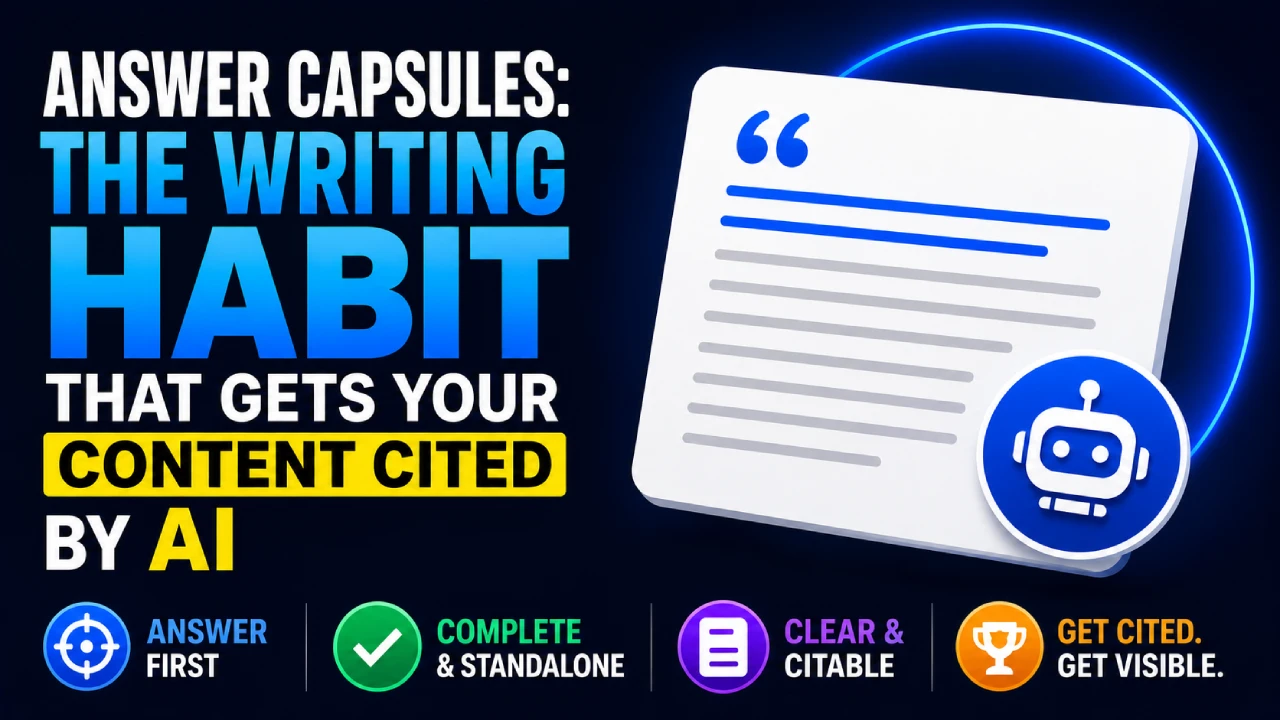
An answer capsule is a paragraph (or tight paragraph cluster) that functions as a complete, standalone answer to one specific question. It contains the claim, the mechanism or reason behind it, any critical qualifier, and enough named entities and context to make sense when read with nothing else around it. The self-check is simple: cover everything above this paragraph and everything below it. Does what remains still answer a question completely and accurately? If yes, it’s an answer capsule. If not, it has a failure mode — and there are four specific ones, each fixable.
This article names those failure modes, demonstrates each with a WordPress-relevant before/after example, and gives you a per-paragraph habit that becomes automatic within a few weeks of consistent practice.
The Mechanical Reason This Matters
Before the technique, the mechanism — because understanding why this works makes it easier to apply consistently.
When AI retrieval systems process your page, they don’t read it the way a human does. As covered in Day 3 of this series, they split the content into chunks — typically 200 to 500 tokens each, roughly 150 to 375 words — convert each chunk into a vector representation, and evaluate those chunks independently for relevance to whatever question a user has asked. The winning chunk gets extracted and placed in an AI-generated answer.
That extraction step is what changes everything about paragraph-level writing. A chunk that references something established in the previous chunk becomes ambiguous once the chunks are separated. “This approach,” “the method described above,” “because of what we just covered” — all of these work perfectly in flowing prose and completely fail once the paragraph is evaluated alone.
This is distinct from “clear writing” as a general standard. Clear writing makes prose easy for a human to follow in sequence. Extraction-ready writing makes each paragraph defensible as a standalone unit. You need both — but the second is what produces AI citations, and most GEO writing advice conflates the two without naming the distinction.
What an Answer Capsule Contains
A complete answer capsule has five components, all within a single paragraph or tight two-paragraph cluster:
The claim — a specific, direct statement that answers the question. Not a setup, not a preview, not a topic sentence that promises an answer. The actual answer.
The mechanism or reason — why the claim is true, in one sentence. This is what separates a citable claim from a bare assertion, and it’s what makes the extraction feel authoritative rather than hollow.
Any critical qualifier — the main condition under which the claim doesn’t apply. Not every claim needs this, but omitting a meaningful qualifier makes the extraction inaccurate.
Named entities — the specific plugin, tool, platform, setting, or concept by name. Generic language (“a popular option” or “some plugins”) can’t be cited accurately because there’s nothing to attribute the claim to.
Standalone context — any background needed to understand the claim that would otherwise come from surrounding paragraphs. Often this is just a single orienting phrase: “When configuring a WordPress site on shared hosting…” tells a reader who extracted only this paragraph what situation the advice applies to.
Annotated example:
Enabling object caching on a WordPress site reduces database query time on pages with repeated, identical queries — such as navigation menus and widget areas — because cached query results are stored in memory rather than re-executed on every page load. [claim + mechanism] WP Redis and Memcached are the two most widely supported object caching backends for WordPress, with WP Redis generally preferred when your hosting environment supports Redis. [named entities] This applies specifically to object caching, not page caching — the two are separate systems that solve different performance problems. [qualifier + standalone context]
That paragraph answers “what is object caching in WordPress and how does it work” completely, with no dependencies on surrounding text. Any AI system extracting it gets a complete, citable answer.
The Four Failure Modes
These are the four specific patterns that consistently prevent otherwise good paragraphs from becoming citable. Each has a name, a demonstration, and a fix.
Failure Mode 1: The Pronoun Trap
What it is: The paragraph opens with a pronoun or demonstrative (“This,” “It,” “They,” “These”) that refers to something established in the previous paragraph. Extracted in isolation, the pronoun has no referent.
Before (fails extraction):
This makes a significant difference to your site’s perceived loading speed. It works by displaying a lower-resolution version of images immediately while the full-resolution file loads in the background. Most modern WordPress themes support it natively, and enabling it takes about 30 seconds in your media settings.
Extracted alone: “This makes a significant difference” — to what? “It works by” — what does? The paragraph is completely dependent on whatever came before it.
After (extraction-ready):
Lazy loading images in WordPress improves perceived page load speed by displaying low-resolution placeholders immediately while full-resolution files load in the background as users scroll toward them. Most modern WordPress themes enable lazy loading natively; if yours doesn’t, the setting appears under Settings → Media in your WordPress dashboard and takes about 30 seconds to activate.
Now every sentence works without context. The named entity (lazy loading), the mechanism, the qualifier (if yours doesn’t), and the specific location in WordPress are all present.
The fix: Read your paragraph’s first sentence and ask: does it contain the subject it’s describing, by name? If it starts with “This,” “It,” or “They,” either replace the pronoun with its referent or rewrite the opening to state the subject directly.
Failure Mode 2: The Buried Lede
What it is: The key claim appears in sentence four or five after establishing context. AI systems evaluating a chunk’s relevance weight earlier content more heavily — a paragraph that spends three sentences building up to its point is less likely to be recognized as relevant to a specific question than one that states the point first.
Before (fails extraction):
When you’re running a WordPress site that receives a lot of traffic, server resources become a significant concern. As your visitor count grows, so does the load on your database. This can create bottlenecks that slow everything down. That’s why caching is considered one of the most effective performance optimizations available to WordPress site owners — it can reduce server load by 60-80% on repeat visits.
The actionable claim (“caching reduces server load by 60-80%”) is in the fourth sentence. Three sentences of contextual buildup precede it.
After (extraction-ready):
A page caching plugin reduces WordPress server load by 60-80% on repeat visits by serving pre-built static HTML files instead of dynamically generating each page on every request. This makes caching the single most impactful performance optimization available to most WordPress site owners — particularly those on shared hosting where database connections are a common bottleneck.
The specific claim, the mechanism, the percentage, and the qualifying context (shared hosting) are all present in the first two sentences.
The fix: Take the most specific, concrete claim in your paragraph and move it to sentence one. Everything else — context, elaboration, qualification — follows. This is the BLUF (Bottom Line Up Front) principle applied at the paragraph level, not just the post level.
Failure Mode 3: The Hedge Spiral
What it is: The paragraph accumulates so many qualifications that no extractable claim remains. Some hedging is necessary and honest — but when the claim itself is hedged, there’s nothing for an AI system to cite.
Before (fails extraction):
The impact of image optimization on Core Web Vitals can vary quite a bit depending on your particular setup. In some cases, it might help with your LCP score, though this isn’t always guaranteed. Depending on your hosting environment and existing setup, you could potentially see some improvement, but it really depends on what else is going on with your site and what images you’re using.
No specific claim exists here. “Can vary,” “might help,” “isn’t always guaranteed,” “could potentially,” “really depends” — the paragraph has no extractable content because the claim has been hedged into nonexistence.
After (extraction-ready):
Optimizing your largest above-the-fold image — the one that determines your LCP score — typically produces the largest Core Web Vitals improvement available through image work alone. Converting that image to WebP format and preloading it via your theme’s header reduces LCP loading time on most WordPress sites with image-heavy above-the-fold content. Other images on the page have less impact on Core Web Vitals because they load after the LCP measurement window closes.
The claim is specific. The qualifier is real (“above-the-fold image,” “most WordPress sites with image-heavy above-the-fold content”) rather than a blanket hedge. The paragraph makes a falsifiable, attributable statement.
The fix: Identify your paragraph’s core claim, stripped of hedges. State it first. Then add a single specific qualifier that actually limits the claim meaningfully — not a general “it depends” but a named condition (“on shared hosting,” “for sites with more than 50 posts,” “when using a page builder”). Replace spiral-hedging with one precise qualifier.
Failure Mode 4: The Narrative Dependency
What it is: The paragraph only makes sense as part of a sequence — it’s a “step 3” that references steps 1 and 2 implicitly without naming them. In a how-to flow this reads naturally; extracted independently it becomes a fragment of a process the reader has no context for.
Before (fails extraction):
Once you’ve done that, click Save Changes and navigate back to the main settings page. You’ll see the new configuration reflected in the status panel at the top. From here you can test whether the change worked by using the built-in diagnostic tool.
Extracted alone: “Once you’ve done that” — done what? “The main settings page” — of which plugin?
After (extraction-ready):
After enabling WP Super Cache’s CDN integration by entering your CDN URL in the CDN settings tab, click Save Changes and return to the plugin’s main dashboard. The status panel at the top of the dashboard confirms whether the CDN connection is active. Use the “Test Cache” button on the main dashboard to verify that pages are being served from your CDN rather than your origin server.
Now the extracted paragraph names the plugin (WP Super Cache), the specific setting (CDN integration), the location (CDN settings tab), and the verification method. A reader who sees only this paragraph knows exactly what plugin they’re working with and what step they’re on.
The fix: For every how-to step, name the plugin, tool, or interface in the step itself — not just in the heading above it. Replace “click the button” with “click the Save Changes button in WP Super Cache’s General settings tab.” Add enough named context that the step makes sense without the steps before it.
The 30-Second Per-Paragraph Self-Check
Before moving to the next paragraph while writing or editing, run this test:
Cover everything above and below the paragraph. Read only what’s left. Ask three questions:
- Does this paragraph answer a specific question completely — without needing any surrounding context to make sense?
- Does it contain the subject by name (not “this,” “it,” or “the above method”)?
- Does it make a specific, attributable claim — not a general observation or a hedge?
If the answer to all three is yes: the paragraph is an answer capsule. Move on.
If the answer to any is no: identify which failure mode applies (pronoun trap, buried lede, hedge spiral, or narrative dependency) and apply the specific fix for that mode.
This takes about 30 seconds once the failure modes are familiar. Within 2-4 weeks of applying it consistently, the extraction-ready pattern starts to appear in first drafts rather than requiring deliberate revision.
Applying the Habit to Different Paragraph Types
The answer capsule principle applies differently depending on what the paragraph is doing:
Definition paragraphs need the term, a complete one-sentence definition, and the key differentiator (what it’s not, or what makes this definition specific). The hedge spiral is the most common failure mode here — “generally speaking” and “in most cases” undermine the definition’s extractability.
Explanation paragraphs (covering mechanisms, reasons, or how something works) need the claim first, then the mechanism, then a concrete example from WordPress if possible. The buried lede is the most common failure mode — writers naturally build to the mechanism rather than leading with it.
Comparison paragraphs work best as tables (covered in Day 8) or as answer capsules that name both options and state the differentiator directly. “WP Super Cache is free and simpler to configure; WP Rocket is paid and provides better performance for most WordPress setups” is an extractable comparison claim. “There are different options depending on your needs” is not.
How-to step paragraphs must name the plugin/tool/interface in the step itself, not rely on the surrounding heading or previous steps. The narrative dependency failure mode is almost universal in how-to content, making it the highest-volume opportunity for improvement across an existing content archive.
What Specificity Does to Citation Rates
The Princeton GEO study — the most rigorous academic analysis of generative engine optimization tactics — found specific, quantifiable improvements when content moved from general to specific:
Adding statistics to content increased AI citation visibility by 22%. Adding expert quotes with named attribution increased it by 37%. Adding authoritative source citations increased visibility by up to 115% for content already ranking in the middle of the first page.
These aren’t suggestions to add filler data points. They’re evidence that specificity itself — moving from “page caching improves performance” to “page caching reduces server load by 60-80% on repeat visits (WP Super Cache documentation)” — is the mechanism behind citation. AI systems are, in part, selecting for claims they can attribute with confidence. A vague generalization is difficult to attribute; a specific, sourced claim is easy to extract, easy to attribute, and harder for the AI to accidentally misquote.
For WordPress content specifically, this means: when you state a performance improvement, name the percentage and the source. When you recommend a plugin, name the use case and the limitation. When you describe a setting, name its location within the WordPress dashboard. Every step toward specificity is a step toward citeability.
Rewriting an Existing Post: A Worked Example
Here’s a real paragraph from a typical WordPress performance guide, diagnosed and rewritten:
Original:
Another thing to consider is your database. As your site grows, the database can become a source of slowdowns, especially if you haven’t done any maintenance on it. There are plugins that can help with this, and running them periodically can make a noticeable difference to how fast your site loads, especially on pages with a lot of dynamic content.
Diagnosis:
- Failure Mode 2 (Buried Lede): “can make a noticeable difference” is buried behind setup sentences
- Failure Mode 3 (Hedge Spiral): “can become,” “can help,” “can make,” “noticeable difference” — no specific claim
- No named entities: no plugin name, no specific setting, no percentage improvement
After (extraction-ready):
WordPress databases accumulate overhead over time — deleted posts, expired transients, and post revisions that remain in the database but are never used. WP-Optimize or Advanced Database Cleaner can remove this overhead in one click, with WP-Optimize’s free tier sufficient for most blogs and small sites. Running a database cleanup monthly reduces query execution time on dynamic pages, with the largest improvement typically visible on archive pages and search results that execute multiple complex queries per page load.
What changed:
- Lede moved to first sentence (what accumulates and why)
- Two specific plugin names with a differentiator (WP-Optimize’s free tier)
- Specific use case for when improvement is most visible (archive pages, search results)
- “Reduced query execution time” instead of “noticeable difference”
- Monthly cadence stated specifically
The rewrite is roughly the same length. It took about 3 minutes. It passes all four failure mode checks.
The Daily Writing Habit
The full answer capsule method — applying all five components and checking all four failure modes for every paragraph — is a skill that takes several weeks to become automatic. Here’s a practical path to building it:
Week 1-2: Apply the 30-second self-check to every paragraph after writing it. Identify which failure mode appears most often in your current writing. Most writers have one dominant pattern — usually either pronoun trap or buried lede.
Week 3-4: Apply the fix for your dominant failure mode before the self-check. You’ll notice the check takes less time because you’ve already addressed the most common issue.
Week 5+: The extraction-ready pattern starts appearing in first drafts without deliberate revision for the most common paragraph types. The self-check becomes a scan rather than a full diagnostic.
One useful daily anchor: at the end of every writing session, pick one paragraph from what you just wrote and apply the full five-component checklist. Not every paragraph, just one. This builds the diagnostic habit without adding significant time to your writing process.
Frequently Asked Questions
What makes a paragraph “extraction-ready” vs. just “clearly written”? A clearly written paragraph is easy for a human to follow in sequence. An extraction-ready paragraph makes complete sense when read in complete isolation, with nothing before or after it. The distinction: clear writing can rely on the surrounding text for context; extraction-ready writing carries its own context within the paragraph itself.
How long should an answer capsule be? AI retrieval chunks are typically 200-500 tokens — roughly 150 to 375 words. For most explanatory paragraphs, 80-150 words per answer capsule is the practical target. Long enough to include all five components; short enough to function as a single, cohesive extractable unit. For complex topics, a two-paragraph capsule is acceptable, but both paragraphs should be able to stand alone.
Is writing for AI the same as writing for featured snippets? Closely related but not identical. Featured snippet optimization focuses on the opening answer to one specific query at the post level. Answer capsule technique extends that principle to every explanatory paragraph throughout a post, because AI systems extract individual passages, not just the opening section.
Do I need to rewrite all my existing posts? No. Apply the retroactive audit triage from Day 8 — focus first on your highest-traffic posts covering questions users frequently ask AI systems. Within each post, the most impactful single change is usually the first paragraph of each major H2 section. Fix those openings before anything else.
Does this make content feel robotic or formulaic? Only if “answer-first” is confused with “mechanical.” Stating the key claim in sentence one doesn’t prevent clear explanation, vivid examples, or a distinctive voice in the sentences that follow. The constraint is on structure (claim first, context second), not on tone or style.
Where to Go From Here
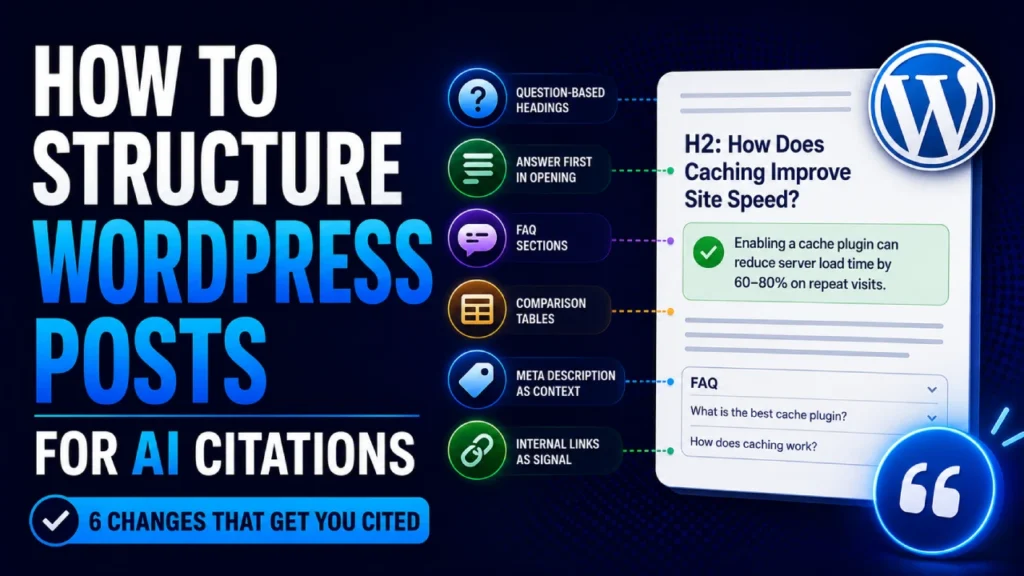
The answer capsule habit is the paragraph-level complement to Day 8’s post-level structure. Together they address the full extraction chain: Day 8 creates the right containers (headings, FAQ sections, tables), Day 9 fills those containers with content that survives the extraction process.
From here, the series continues with:
- Schema and Structured Data for WordPress — adding the machine-readable layer that helps AI systems identify what type of claim each paragraph contains
- Content Freshness Signals — how update dates, current statistics, and recency markers affect citation rates in retrieval-based AI systems
- The WPGeoPress Workflow (Day 21) — putting Days 1-20 together into a complete, plugin-assisted implementation for a WordPress site
Every paragraph you write from here forward is an opportunity to practice the self-check. The habit compounding across an entire content archive is what produces measurable changes in citation rates — not any single optimized post, but consistent, repeatable extraction-ready writing across everything you publish.