If you spend any time reading about AI search, you’ll notice something strange: the experts don’t agree, and they don’t just disagree a little.
Some say SEO is dead. Some say GEO is just SEO with a rebrand. Some say the whole “SEO vs. GEO” framing is a distraction from a bigger problem. All three camps have smart, credentialed people defending them.
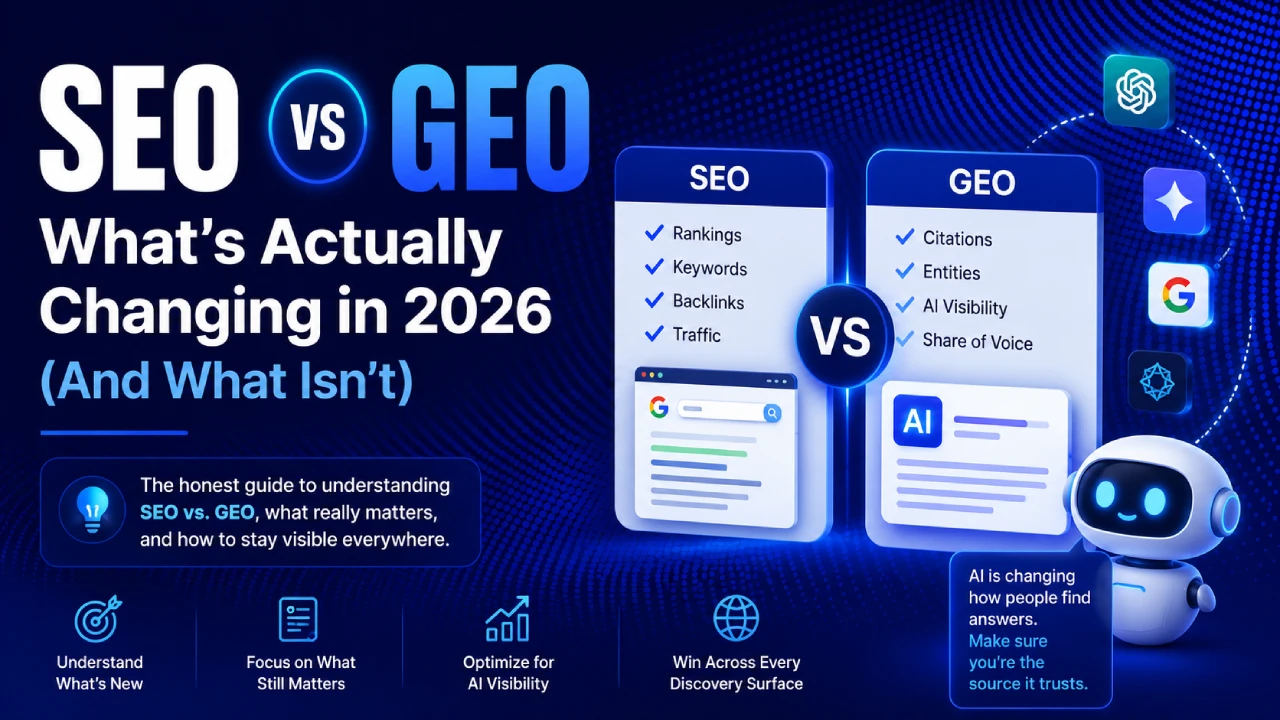
Here’s the honest synthesis: roughly 80% of what makes content succeed in GEO is identical to what’s made content succeed in SEO for years — quality, structure, technical accessibility, credibility. The remaining 20% is genuinely new, and it’s specific enough to matter. This guide walks through exactly which part is which, because that distinction is more useful than picking a side in the debate.
The Three Camps in the GEO Debate
It’s worth seeing the disagreement laid out plainly, because once you do, the “right answer” becomes obvious.
Camp 1: “Nothing has really changed.” Google’s own representatives have repeatedly said, in essence, that good SEO is good GEO. A well-known SEO influencer, Will Scott, has put it almost identically: GEO is “just SEO if you’ve been doing good SEO.” A long, detailed Reddit thread in r/SEO — one of the more grounded discussions on this topic anywhere online — makes a sharper version of this argument: that large language models aren’t independent search engines with their own ranking systems at all, but tools that lean on existing search infrastructure (Google, Bing, or web-scraping APIs) to retrieve results, meaning the “new” GEO tactics are mostly just long-tail keyword targeting wearing a new name.
Camp 2: “Enough has changed to treat it as distinct.” Other practitioners point to concrete behavioral differences: content now gets evaluated and extracted at the paragraph level instead of the page level; success is measured in citations and mentions instead of clicks and rankings; and different AI platforms behave differently enough that the same content performs unevenly across them. A live audit comparing how Google AI Overviews, Perplexity, ChatGPT, and Gemini each answered the identical question found four genuinely different approaches — different top picks, different formats, different sourcing behavior. That’s not “nothing changed.”
Camp 3: “You’re asking the wrong question.” A more recent line of thinking argues that debating SEO vs. GEO at all misses the real shift: discovery has fragmented across so many surfaces — Google, ChatGPT, TikTok, Reddit, YouTube — that optimizing for any single channel, whether it’s called SEO or GEO, is already the outdated approach. The real goal, in this view, is unified visibility across every surface where your audience might encounter you, not a rebranded ranking strategy for one new platform.
Our synthesis: Camp 1 and Camp 2 are both right, just measuring different things. If you’re asking “does my existing SEO foundation still matter?” — yes, overwhelmingly (Camp 1). If you’re asking “should I write and structure content identically to five years ago?” — no, some real adjustments help (Camp 2). Camp 3 is the most forward-looking, and worth keeping in mind as a long-term direction, but for a working WordPress site today, it’s more useful to get the SEO/GEO fundamentals right first before worrying about TikTok and Reddit as discovery surfaces.
What’s Staying Exactly the Same
Let’s clear this part first, because it’s reassuring and it’s most of the picture:
- Quality content still wins. Both traditional search and AI systems reward content that’s genuinely useful, accurate, and well-researched over thin or derivative material.
- Technical accessibility still matters. If a page can’t be crawled, indexed, or rendered properly, it’s invisible to Google and to most AI retrieval systems alike — nothing about GEO changes that baseline requirement.
- E-E-A-T still applies. Experience, expertise, authoritativeness, and trust signals — real author bios, credible sourcing, transparent expertise — influence both how Google ranks you and how confidently an AI system frames a citation to you.
- Backlinks and authority still count. Sites with strong backlink profiles and established authority are more likely to be crawled, indexed, and treated as credible sources by both systems.
- Page speed and site health still matter. Slow, unstable, or poorly built sites lose ground in both traditional rankings and AI retrieval reliability.
If your WordPress site already does these things well, you are — genuinely, not as a sales pitch — most of the way to being “GEO-ready” already.
What’s Genuinely Different in 2026
This is the 20% worth paying attention to.
1. Paragraph-level evaluation, not just page-level. Traditional SEO optimizes a whole page to rank for a keyword. AI systems doing retrieval-augmented generation break pages into chunks and evaluate which specific passages answer a question well enough to extract — independent of how the rest of the page performs. A page can be well-optimized overall and still contain paragraphs that are useless for extraction because they rely on context (“as mentioned above,” “this is why”) that disappears once the paragraph is lifted out.
2. Entities and context outweigh exact-match keywords. Keyword-based SEO still works for ranking, but AI systems are built around identifying entities (a person, brand, product, concept) and understanding the relationships between them — not matching literal strings of text. A long, conversational, multi-step prompt like “I have two dogs and hardwood floors, what vacuum should I get?” has almost no exact keyword overlap with “best vacuum for pet hair,” even though it’s the same underlying need. Content written to answer the underlying question, not just to contain the keyword phrase, performs better across both systems.
3. Citations and mentions replace clicks as the success metric. This is the most structurally different part. In traditional SEO, a ranking with zero clicks is a failure. In GEO, being cited, summarized, or mentioned inside an AI answer can be a success even when it generates zero direct traffic — because the value shows up later, indirectly, as brand recognition or a branded search rather than a tracked referral.
4. Different AI platforms genuinely behave differently. This is the part Camp 1 tends to understate. When the same query was run across Google AI Overviews, Perplexity, ChatGPT, and Gemini in one comparative test, each platform produced a different top recommendation, a different format (comparison table vs. plain paragraph vs. list), and different sourcing transparency — Perplexity showed citations prominently, ChatGPT synthesized without visible sources, Gemini gave a vaguer answer with no structure at all. Optimizing for “AI search” as a single monolithic target is a mistake; the platforms don’t behave the same way.
SEO vs GEO: A Behavioral Comparison
| Traditional SEO | GEO in Practice (2026) | |
|---|---|---|
| Unit of evaluation | Whole page | Individual paragraph or passage |
| Query style | Short keyword phrases | Long, conversational, multi-step prompts |
| What “winning” looks like | High ranking, high click-through | Citation, mention, or summary inclusion |
| Content structure reward | Keyword placement, headings, internal links | Self-contained explanations, front-loaded answers, clear entity definitions |
| Cross-platform consistency | Fairly consistent within Google | Genuinely inconsistent — each AI platform weighs signals differently |
| Attribution to your site | Trackable via clicks and referral traffic | Often untrackable — the “measurement blind spot” |
| Update cadence pressure | Freshness helps, not always critical | Retrieval-based systems seem to favor recency more heavily |
A Mini Example: One Query, Two Kinds of GEO
Say a WordPress site publishes a post titled “Best Caching Plugin for WordPress in 2026.” Here’s roughly how it plays out on the two flavors of GEO covered in Day 1 of this series:
Google AI Overview pulls from Google’s own indexed, ranked results — largely the same retrieval and ranking systems behind ordinary Google Search. If the post already ranks reasonably well and is technically sound, it’s already in the eligible pool; no special AI-only formatting is required, per Google’s own guidance.
A retrieval-based chatbot (ChatGPT with browsing, Perplexity) runs its own search, retrieves several candidate pages, chunks them, and pulls out whichever specific passage most directly and clearly answers “what’s the best WordPress caching plugin.” A post that states its recommendation and reasoning in one self-contained early paragraph — plugin name, key benefit, one caveat — is far more extractable here than one that builds up to a verdict slowly across ten paragraphs of scene-setting.
Same post, same publish date, two different mechanisms deciding whether it gets used — which is exactly why “optimize for AI search” as a single instruction is too vague to act on.
The Skeptic’s Take: Is GEO Overhyped?
It’s worth taking the pushback seriously rather than waving it away, especially since it comes from experienced practitioners, not just contrarians.
The strongest version of the skeptical argument, echoed across a long and detailed Reddit discussion among working SEOs, is this: several of the specific tactics marketed as “GEO best practices” — that AI systems “prefer” certain content formats, that unlinked brand mentions carry outsized weight, that particular platforms have distinct ranking algorithms independent of existing search infrastructure — are asserted more confidently than the evidence actually supports. Some of that confidence, the argument goes, is commercially motivated: companies selling GEO monitoring tools and GEO consulting have a direct financial incentive to frame this as a bigger, more urgent shift than it may be.
That’s a fair caution, and it’s worth holding two things at once:
- What’s well-evidenced: Google’s own documentation confirms AI Overviews rely on the same core ranking and indexing systems as regular Search. The mechanical description of retrieval-augmented generation — chunking, retrieval, synthesis — is documented and consistent across sources. The fact that different AI platforms produce different answers to the same query is directly observable, not speculative.
- What’s genuinely less certain: Specific claims about exactly how much weight unlinked brand mentions carry, precisely which content formats each private AI model favors internally, and how durable any of today’s “GEO tactics” will remain as these systems keep changing — all of that is closer to informed inference than settled fact, and should be treated with appropriate humility.
The practical takeaway: build on the well-evidenced fundamentals (technical accessibility, content quality, clear structure, credible authorship), and treat more specific, tool-vendor-promoted tactics with a healthy amount of skepticism until you can verify them yourself.
Stop / Keep / Start: A Blunt Triage for WordPress Site Owners
Stop doing:
- Chasing exact-match keyword density as a primary content strategy
- Assuming a ranking with no clicks is automatically a failed page
- Treating every AI platform as if it behaves identically
- Overhauling your entire content strategy based on any single vendor’s GEO claims without checking it yourself
Keep doing:
- Publishing genuinely useful, well-researched, people-first content
- Maintaining strong technical SEO — speed, crawlability, mobile-friendliness
- Building real backlinks and topical authority
- Writing clear author bios and maintaining transparent expertise signals
Start doing:
- Making your opening paragraph answer the core question directly, without a slow build-up
- Writing key explanatory paragraphs so they make sense read in isolation, out of context
- Tracking (even informally) whether ChatGPT and Perplexity mention your brand or content for questions in your niche
- Keeping high-value, evergreen posts periodically refreshed, since retrieval-based systems appear to weight recency more heavily than Google traditionally has
Auditing Your Existing Content Library for GEO
Most WordPress site owners reading this aren’t starting from zero — you likely have dozens or hundreds of existing posts. A full rewrite isn’t necessary or realistic. Instead:
- Identify your top 10–20 traffic-driving or topically important posts using Search Console or your analytics of choice.
- Check each one’s opening paragraph — does it answer the core question in the first two or three sentences, or does it warm up first?
- Scan for “orphaned reference” paragraphs — sentences that only make sense with surrounding context (“as we covered above,” “this is why it matters”). Rewrite the ones carrying key facts so they stand alone.
- Confirm author bios and expertise signals are present and consistent across the post and your site generally.
- Note publish/update dates on your most important posts — if a high-value post hasn’t been touched in over a year, it’s a good freshness-update candidate.
- Leave the rest alone. Not every post needs this treatment — prioritize the pieces doing the most topical or traffic work for your site.
This kind of targeted audit, done across your best-performing content, gets you most of the practical benefit without the cost of rewriting an entire archive.
Why the Confusion Persists
It’s worth asking, briefly, why five credible sources can look at the same landscape and reach three different conclusions. Part of the answer is timing: AI search platforms are genuinely evolving month to month, so an accurate description of ChatGPT’s behavior in early 2025 may already be outdated by the time you read it. Part of it is incentive: companies selling GEO monitoring tools benefit from framing this as a large, urgent, distinct discipline, while companies focused on core SEO product lines have reason to frame it as “nothing new.” And part of it is genuinely open research — nobody outside the AI labs themselves has full visibility into exactly how each system weighs signals, so even good-faith practitioners are reasoning from limited, indirect evidence.
None of that means the topic is unknowable. It means treating any single confident claim — including strong claims in either direction — with a bit of healthy caution, and prioritizing the mechanics that are actually documented (how RAG retrieval works, what Google has stated about its own systems, what’s directly observable by testing prompts yourself) over claims that can’t be independently verified.
Frequently Asked Questions
Is SEO dead because of GEO? No. Every credible source on this topic — including Google itself — treats GEO as built on top of SEO fundamentals, not a replacement for them. The sites most likely to succeed in AI visibility are the ones already doing solid SEO.
Do I need to hire a dedicated GEO specialist? For most WordPress site owners and small teams, no. If you or someone on your team already understands solid SEO, most of those skills transfer directly. It’s more about adding a bit of monitoring and a few structural habits than hiring an entirely new role.
Why do ChatGPT and Google AI Overviews recommend different things for the same question? Because they work differently. Google AI Overviews draws on Google’s own indexed search results. Chatbots with browsing or search capability run their own retrieval process across the open web, which can surface different sources entirely. Neither is more “correct” — they’re just built differently.
Should I trust every GEO tip I read online? Treat specific, narrow claims (particular formats or tactics a platform supposedly “prefers”) with some skepticism, especially from tool vendors with a financial stake in the answer. Broader, well-documented mechanics — like how retrieval-augmented generation works, or Google’s own public statements about AI Overviews — are more reliable ground to build a strategy on.
Do I need to rewrite my entire blog for GEO? No. A targeted audit of your most important, highest-traffic posts — tightening opening paragraphs, making key passages self-contained, and refreshing stale content — captures most of the practical benefit without a full rewrite.
Where to Go From Here
This article covered what’s changing and what isn’t. From here, the natural next steps in this series are:
- Why Your WordPress Site Is Invisible to AI Search — the specific technical and structural reasons WordPress sites often get skipped by AI crawlers
- Structuring Blog Posts for AI Citations — a hands-on guide to the paragraph-level writing habits covered briefly here
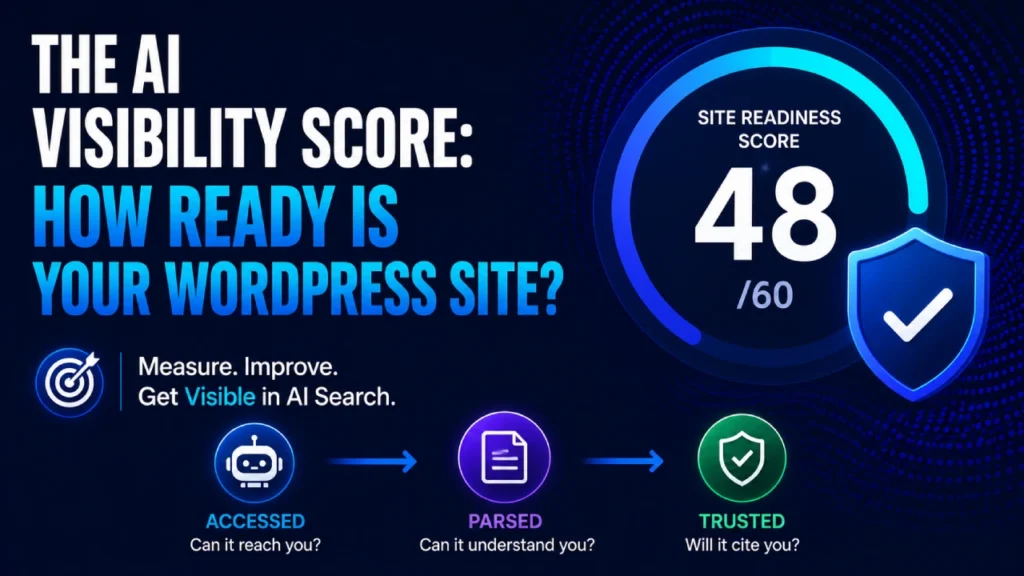
- The AI Visibility Score — turning readiness into something you can actually measure
- WordPress GEO Workflow — the step-by-step plugin-based implementation
The debate over what to call this shift will keep going. What won’t change is that the sites putting in real, consistent effort on both fundamentals and the newer paragraph-level habits are the ones showing up — under whatever name the industry eventually settles on.